
The Baseball Digest Archives 7/84

The recipient of the FIFA Peace Prize has gotten us into yet another unnecessary war in the Middle East. That MF. One of my goals here is to keep things light enough so that it can serve as a temporary respite from, well, everything else in Dystopia ‘26. So we proceed…
July 1984
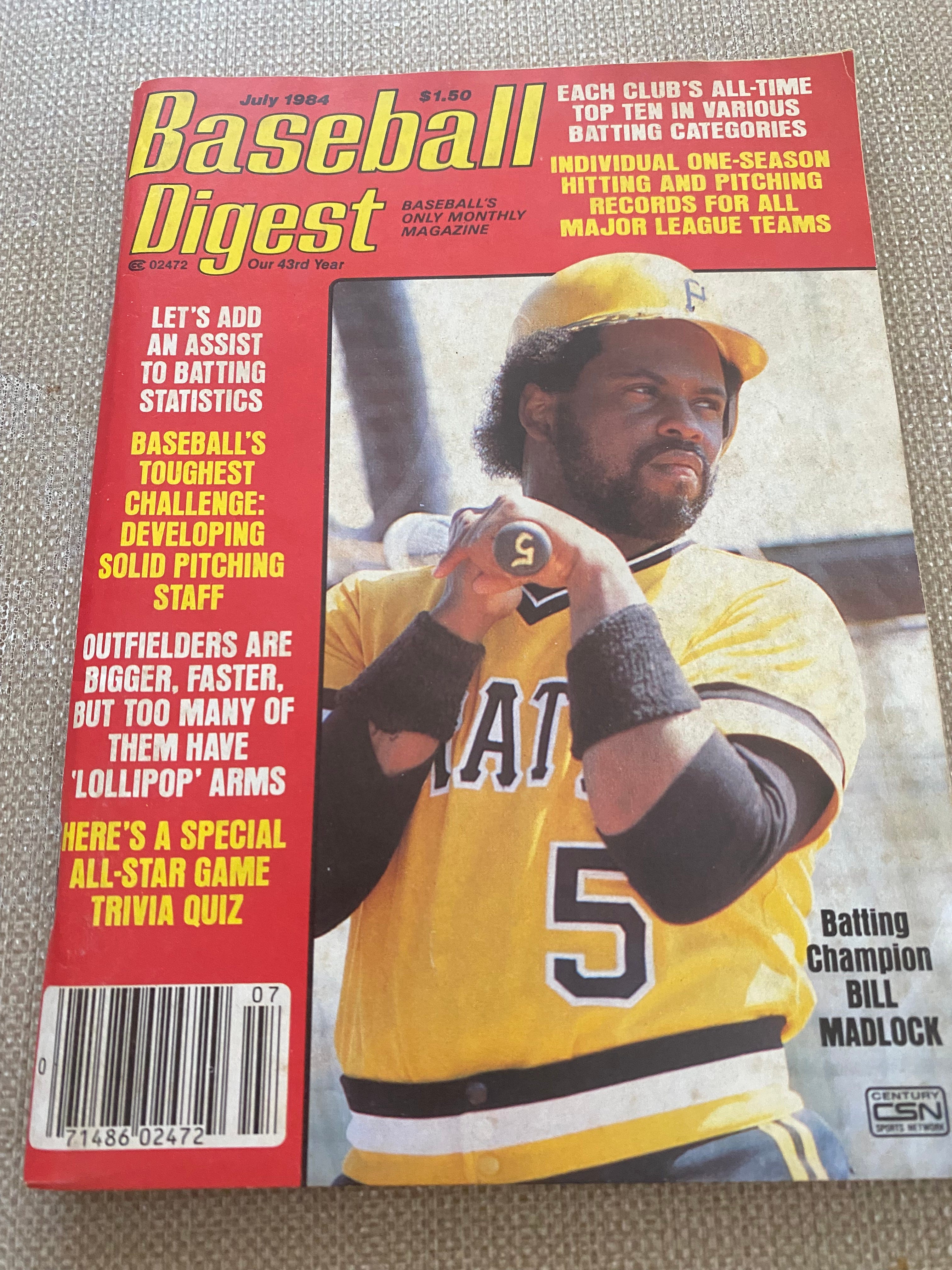
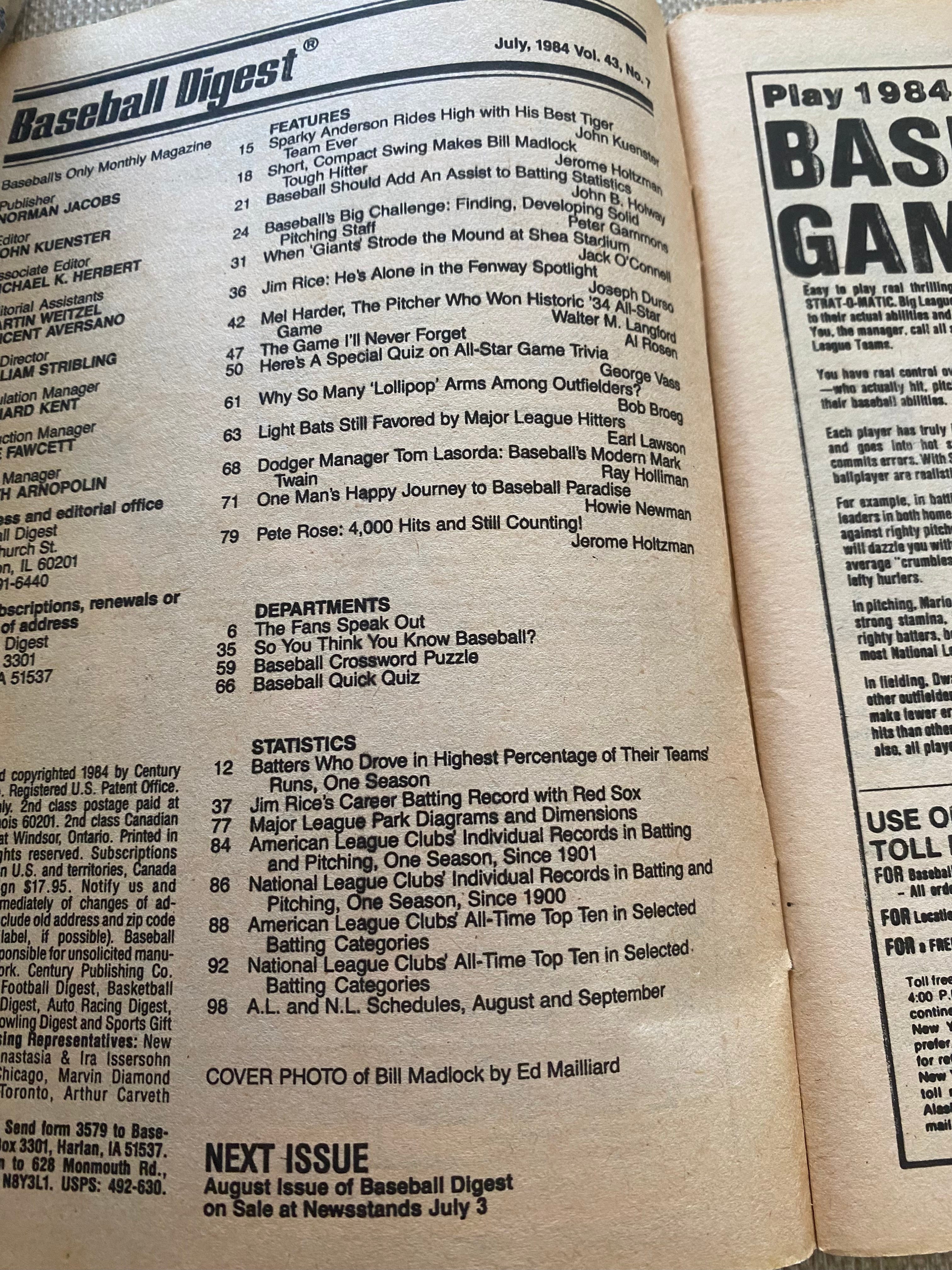
As a periodic reminder an issue of Baseball Digest with a cover date of July would have hit the newsstands in early June, so all of the content would have been written by early to mid May. Much of what happened in the 1984 season would not have been obvious by this early date, but there is one that was. It was in 1984 that the Tigers started off the season on a 35-5 run on their way to a World Series title. By this point in the season it was already clear that this had the makings of a special year. Sparky Anderson had a notable quote in this issue’s lead article on the Tigers. He hoped that he could manage until he turned 75 and that he could surpass 3,000 career managerial wins. It may have been the enthusiasm of a promising start talking, because as great of a manager as he was he fell well short of both goals. 3,000 wins would have placed him second on the all-time list behind only Connie Mack. As it was, he finished with 2,194 wins, ranking him 7th on the current list. And he was 61 years old in his final year at the helm.
At this point in the 1984 season it was less obvious that the Mets were about to enter a new era. My Baseball Digest collection runs from 1975-1986, and because much of this coincided with a particularly poor Mets era, I found it frustrating to see such a small amount of Mets related content in these issues. One article in this issue laments the decline in Mets’ pitching fortunes, and it is framed by looking at the fortunes of a quintet of Mets pitchers from a more glorious time: Nolan Ryan, Tug McGraw, Jerry Koosman, Jon Matlack, and Tom Seaver. Most of these men were at career crossroads, and their declines brought back memories of a bygone era at Shea. Dwight Gooden had made his major league debut by the time this article was written, but not even the most optimistic (delusional?) Mets fan could have dreamed that a golden age in franchise history was about to emerge as quickly as it did.
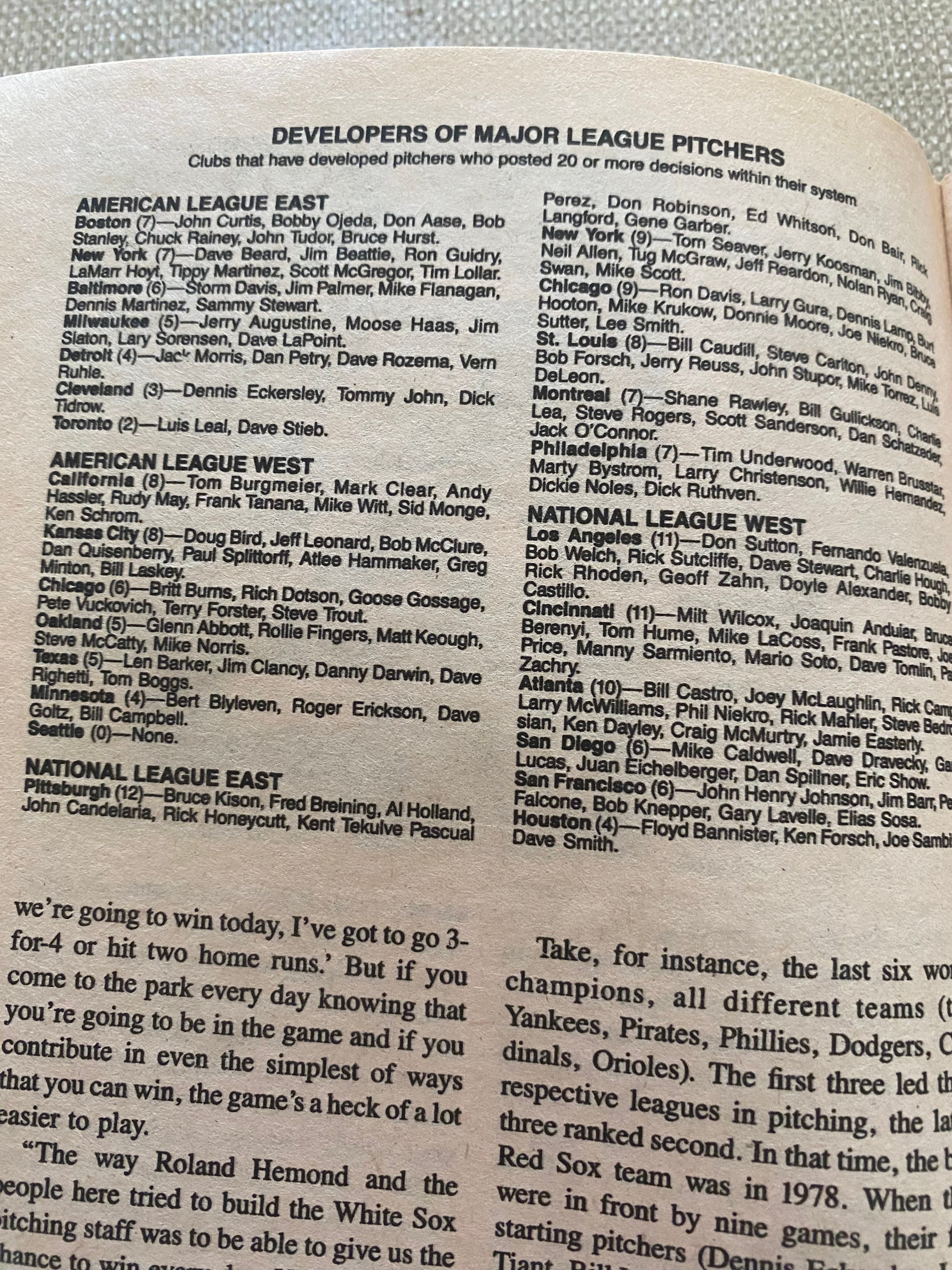
Speaking of pitching, Peter Gammons penned a piece discussing the difficulty of developing young pitchers. It was accompanied by a chart listing how many pitchers each franchise had produced who totaled at least 20 decisions with their clubs. This makes for a great exercise in Remembering Some Guys, or of finding some great answers for Immaculate Grid.
The search for new statistics that can accurately value contributions that a player makes is nothing new. This issue includes one such suggestion; a stat which awards an assist to hitters who advance runners or who extend innings with a hit which may not necessarily produce a run. In addition, the writer believes that catchers should be rewarded with a won-loss record just like pitchers are. There are even more suggestions in the article, many of which are of the throw the spaghetti against the wall to see if it sticks variety. Some of them have since been incorporated into the formulas used to calculate WAR, so there is some prescience to the piece.
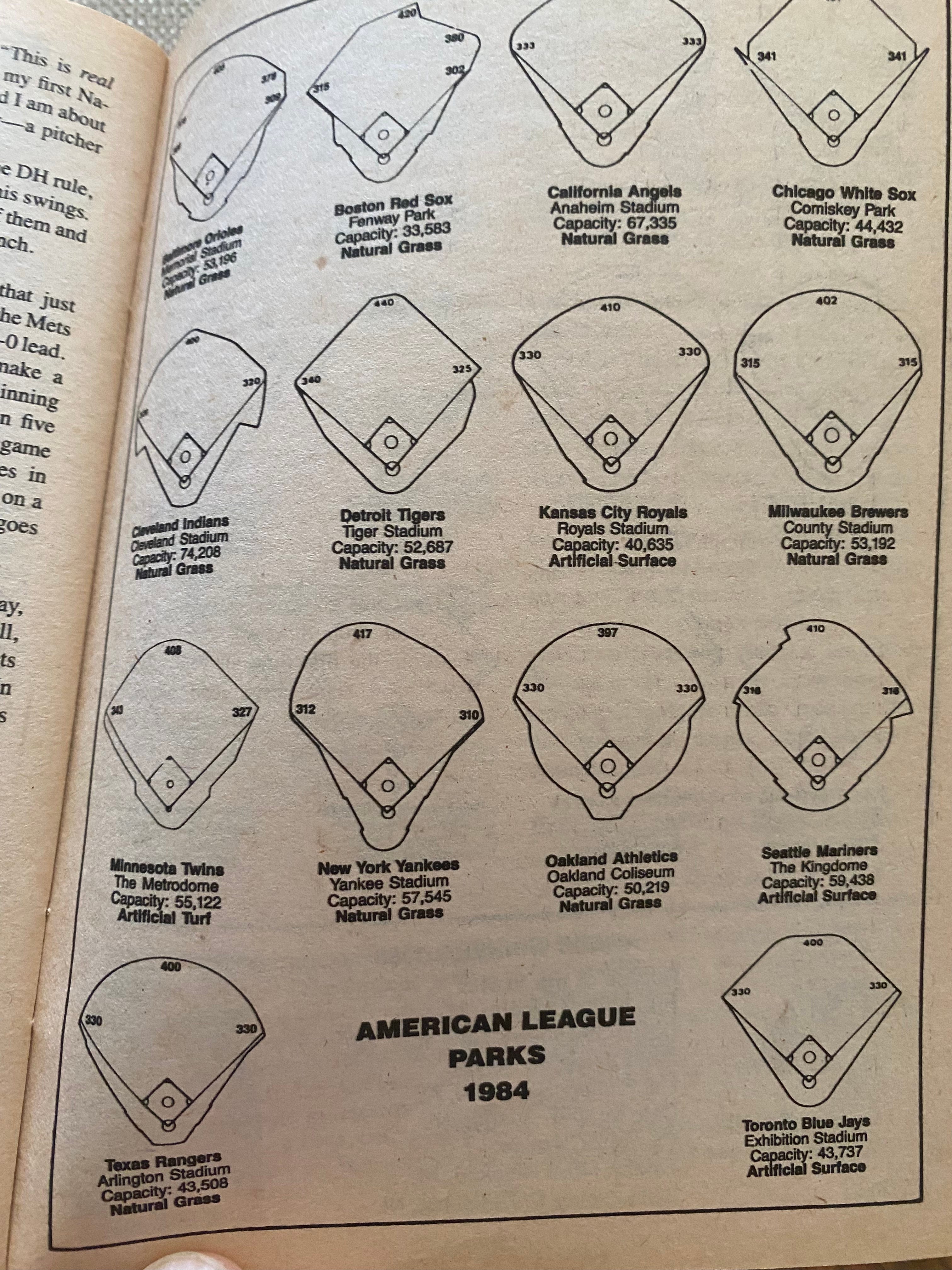
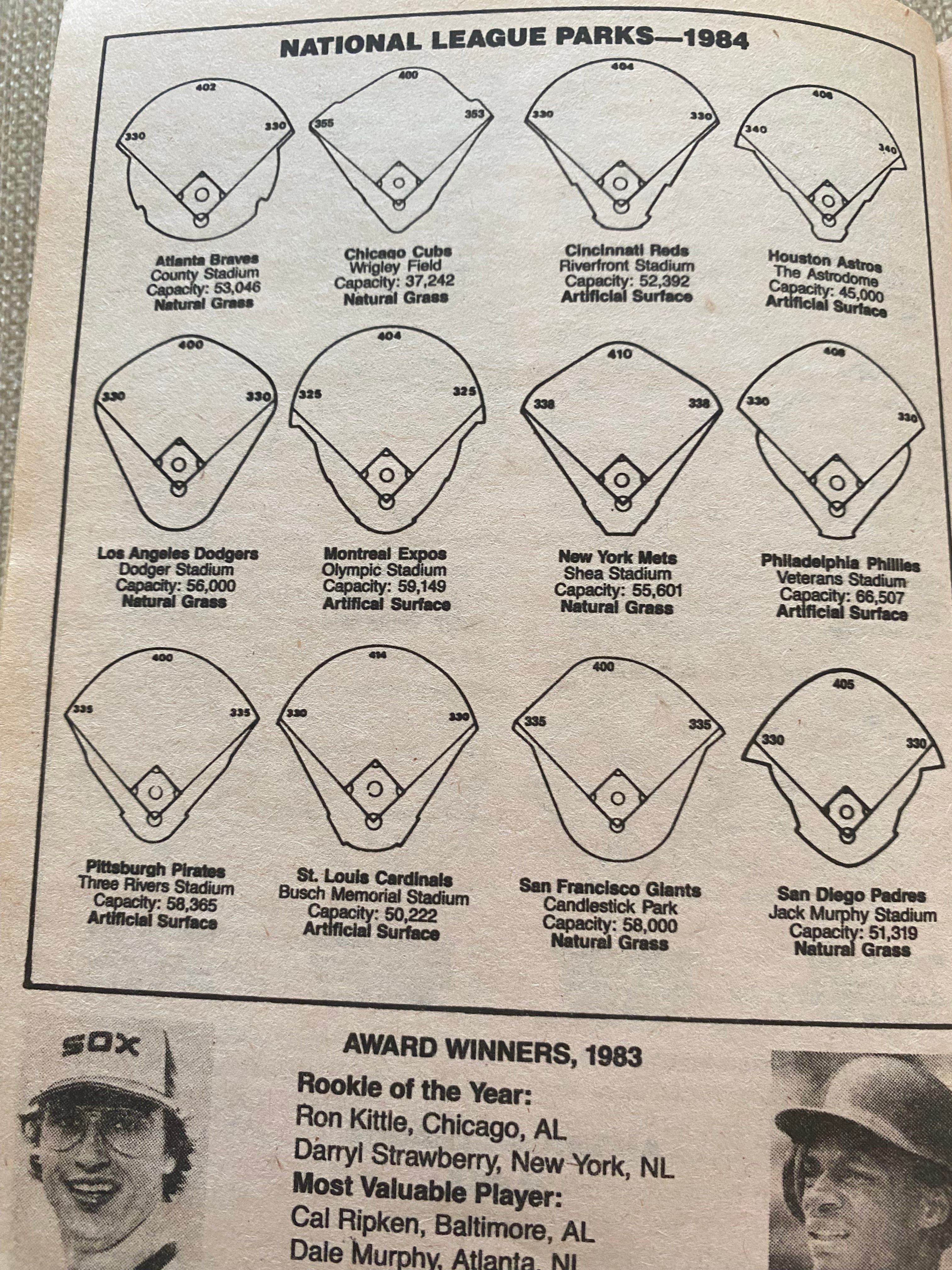
This issue also includes diagrams of the current major league parks. The all-purpose stadiums of the time used to be described as cookie cutters, and you can clearly see that here. It’s amazing how interchangeable each stadium used to be; this is exactly why the wave of retro ballparks pioneered by Camden Yards was such a necessary and welcome change. 1970’s baseball stadiums were so lacking in character. Thank goodness that changed.
Ballot Breakdown - The Black Crowes
I must be missing something, but I just do not understand the fascination that the nominating committee has with The Black Crowes. To be clear, for the most part I genuinely like the radio hits that they had back in the 1990’s and I own 3 Black Crowes CD’s. But there is a huge difference between being good and being HOF good. I don’t believe they are anywhere close to HOF good. The best comparison I can make is that they are similar to some of the second tier classic rock acts that the Hall continues to honor. The difference is that it is much too early to start examining the caliber of 90’s acts emblematic of the Crowes. There are dozens of artists from that era who are much more deserving. The Black Crowes are a textbook example of a band who needs to wait their turn, but instead they have been nominated two years in a row.
They were a true throwback band, adeptly recreating a real southern fried sort of swamp rock. They would not have felt out of place in the lineup of a California Jam festival, slotted in between The Marshall Tucker Band and The Ozark Mountain Daredevils. Lead singer Chris Robinson did a great version of the snake dance, and he and his brother/lead guitarist Rich personified the classic love/hate onstage and offstage relationship often seen in bands with twin leads.
That’s the problem. They didn’t do anything that hasn’t been seen several times before, and it is not as if they did any of this better than their predecessors had. Aping your idols is fine, you just wish that someone doing so would make some sort of step forward from their inspirations. Once again, they were a perfectly fine band, and if there is a ballot 20 years from now in which the Hall is desperately searching for additional 90’s artists, knock yourselves out. This is not their time.
My personal favorite: Jealous Again
If elected, would they perform at the ceremony? Absolutely. Chris Robinson performed in tribute to 2 different acts in last year’s ceremony. And the often feuding Robinson Brothers are currently on very good terms with each other.
Ballot Breakdown - Jeff Buckley
Jeff Buckley was one of the saddest cases of What Could Have Been in memory. He only released one album, but it is an all-time classic, regularly placing high on Greatest Albums lists. His career was all too brief; he accidentally drowned at the age of 30. As an added layer of tragedy his father Tim, an acclaimed singer songwriter in his own right, had died of an overdose at the age of 28. (They were estranged; Jeff was 8 years old at the time of his biological father’s death and had only met him once.)
Blessed with an extraordinary voice and eclectic musical taste, he gained a great deal of attention performing in small clubs in Los Angeles and New York. He set the stage for what was to come with a live EP recorded at the club Sin-é. He released his debut full length album, Grace, in 1994 which immediately wowed the critics. In time one of the album’s tracks would become a timeless standard.
Because his cover of Leonard Cohen’s Hallelujah has become so omnipresent it’s easy to forget that the song which received radio and MTV play upon Grace’s initial release was Last Goodbye. Hallelujah was the song which immediately drew my attention, however. The echo laden production of the record coupled with Buckley’s haunting vocal tone produced something truly special.
Grace would turn out to be his only album. His tragic death occurred while he was in the process of recording his follow-up. In the years following his passing, Hallelujah, or more specifically covers of his arrangement of the song, became a go-to for American Idol contestants. Its overuse has turned the track into something of a cliche, but there is a reason why promising young singers chose that as a showcase. Jeff Buckley was almost otherworldly; if a contestant could come close to matching him that would look very impressive to the judges.
Which leads to the question - how can one properly judge Jeff Buckley as a HOF candidate? There is certainly precedence for the Hall inducting an artist who died young but still made an impact in his short time. One can only wonder how much amazing music he would have brought to the world had he lived. What he left behind showed so much promise. His tremendous talent suggests that he could have been one of the defining artists of his time; he could have just as easily been a beloved cult figure. There is no way of knowing. Each voter will need to determine for themselves if his sparse discography is enough and/or if the promise he showed was enough to warrant their vote.
My personal favorite: Hallelujah
If elected, how will the Hall honor him?: Cliche time once again, someone will sing Hallelujah in his honor. There would be no shortage of volunteers willing to sing in his place. It would probably be better to use a song that he had written, but it is far and away his signature song, so Hallelujah it is.
Final (For Now) Olympic Thoughts
Before offering comments about the television coverage, one point is necessary. Most of the pictures and graphics that you see come from the international feed. NBC uses cameras to supplement the coverage - that’s where many of the crowd shots of family members come from - but for the most part what you saw was out of NBC’s control. Criticizing the broadcast is fair game, but complaints concerning the visuals are not their fault.
During his years as NBC Sports chief, Dick Ebersol generally did a good job of changing with the times. For years his #1 credo was that nothing is more important than the primetime show, so many of the major events were held back until they could be shown on tape delay. He eventually understood that it was pointless to do so; avoiding spoilers is impossible in the smartphone era. So, the network pleased the viewing audience and began to show the big ticket events live during daytime coverage and re-air them in primetime.
One thing he did not compromise on was that he did not want the on air voices to openly root for American athletes in the booth. Yes, as an American network the primary focus is on the Americans. Yes, it’s reasonable to up the excitement when locals do well. There is a difference between doing that and flat out cheering. Ebersol did not want broadcast booths filled with Hawk Harrelson types. You almost never heard the words “we” or “us.” In fact, on the rare occasions in which an analyst would slip they would often noticeably dial it down the following day. They were clearly sent to the principal’s office for a chat.
Those guidelines are not as rigid since Ebersol has retired. I won’t single anyone out, but there was one event this year in which there was audible applause following an American medal performance. That’s not enough to make me angry, but I would prefer not to hear such blatant homerism. The Olympics are meant to celebrate the greatest athletes in the world, not just those who wear the stars & stripes. I hope this new tendency does not get worse in future Olympic telecasts.
Serving as an Olympic voice is a challenge. The announcers need to thread that needle; many of the sports are unfamiliar to a large segment of the audience. One needs to fully explain the rules and strategies without making those explanations so obvious that it would annoy devoted fans of the niche sports while also not repeating those explanations too frequently. Just as important - make sure to get the pronunciations correct. That’s not asking too much; the play by play man are theoretically experienced enough that they are well acquainted with difficult sounding surnames. It should be even easier for the analysts; they are so closely connected to their sports that they are familiar with the athletes and know very well how each name should be correctly pronounced.
The Winter Olympics are unlike the Summer Games in that NBC does not completely shut down the rest of the sports department for the duration. The network was still airing the NBA, so they couldn’t send everyone to Italy or to the Stamford studio where some of the lower profile sports were called remotely as a cost-saving measure. This point really struck me this year. The A-level talent called the biggest sports: Dan Hicks, Terry Gannon, Leigh Diffey, Kenny Albert, etc. These are all well-known and easily identifiable. So many of the play by play men assigned to the lower profile sports seemingly have the exact same voice; unless they were ID’d on the air it was almost impossible to tell them apart. It’s almost as if they were all grown in a lab somewhere.
There is one type of analyst that I really enjoy listening to. Those are the ones that almost sound as if they are competing themselves. Think back to when Scott Hamilton used to be the figure skating analyst and how he would say “triiiiple toe, douuuuuble loop!” The 2 best current examples are Steve Porino in alpine skiing and Bree Schaaf in skeleton & women’s bobsleigh. Both of them added excitement with their cries of “ooh!” and “oh no!” when things would go wrong. Honorable mention goes to Lindsey Jacobellis, who called the ski and snow cross events. Swimming fans are familiar with the Rowdy Cam, a booth camera which would confirm that Rowdy Gaines is as equally excitable of a spectator as he is as a broadcaster. An iso cam on Jacobellis showed that she was also unable to remain seated as the races took place.
Lastly, going into these games I was concerned over how the spectators would treat American athletes. While it’s true that they booed JV Vance at every opportunity, the crowds for the most part separated American athletes from the American government. They were treated with the same level of enthusiasm and respect which was given to athletes from every other country. I don’t know if that will last; 45/47 turns our nation into more of an international pariah with each passing day. But for now our athletes have not been forced to pay for the sins of our administration. For now. It’s tragically symmetrical that 4 years after Russia invaded Ukraine mere days after the completion of the 2022 Beijing Olympics, we attacked Iran days after Milan/Cortina ended. This country does not deserve to co-host the World Cup, but not only have we blown past the date by which the event could be logistically moved, but FIFA is a much more corrupt organization than even the IOC. As long as the check clears, they will always look the other way.
For all of the messiness which surrounds the Olympics, the sports themselves make everything worthwhile. Every event ends with some combination of joy and relief expressed by the winners. The games take up the bulk of my attention for a period of two and a half weeks every other year and it never disappoints. The Los Angeles 2028 games are less than 2 1/2 years away; let’s hope that by then we are once again worthy of hosting the world. (Seriously. Just last week 8 members of the support staff for Cuba’s World Baseball Classic team were refused admittance to the States. And Iran’s team qualified for the World Cup; their stage play games are all scheduled to be played in the US.)
The Science Fiction Movie Pantheon - RoboCop
I remember that when I first began to see RoboCop posters on the subway walls I thought it looked like a cheap piece of schlock. Shows how much I know. It turned out to be a thrill ride and quickly became a modern day classic. The lesson is that one should not judge a book by its cover.
RoboCop was yet another example of a movie which was set in a future date which is now drawing uncomfortably close. This one took place in the dystopian Detroit of 2029. Violent crime has gone out of control; the police force has been privatized and is now run under the auspices of Omni Consumer Products, a name which does not sound ominous at all, no sir. OCP at first attempts to introduce droid police officers, which backfires when an executive is gunned down during a product demo. Rising corporate weasel Bob Morton (Miguel Ferrer) uses that failure as an opportunity to lobby for his concept, the cyborg RoboCop. This was the first time that I remember having seen Ferrer in anything, and he had already perfected portraying the type of sleazeball for which he was best known.
In the meantime, police officer Murphy (Peter Weller) was newly partnered with Lewis (Nancy Allen) and on their first day as a team they are ambushed by the criminal gang that essentially runs the city. Murphy is killed, but OCP uses his body as the test subject for RoboCop. He battles crime with 4 prime directives - to serve the public trust, to protect the innocent, to uphold the law, and a secretive 4th directive which would be revealed later on. There was one unforeseen glitch in the programming; RoboCop was not supposed to have retained any memories from his human template, yet he still held on to some vestiges of Murphy’s humanity. In addition, he used Murphy’s distinctive gun spin when taking his weapon in and out of his holster. That is how Lewis recognized that beneath all of that metal he was actually Murphy.
The reason why it has become such an enduring classic is that it succeeds on so many levels. There is the sadness of Murphy’s murder along with the poignancy of RoboCop’s flashback memories of Murphy’s wife and son. There is the ultra violence, which was quite controversial at the time but was so over the top without becoming overly cartoonish that it feels like an amusement park ride. There is some great social satire, from the happy news talk interstitials thrown in to the depictions of C-Suite shenanigans.
This is Hollywood, the studio made sure to milk that cash cow for all that it was worth. The movie produced multiple sequels, a TV series, and a remake around a decade ago. Nothing came anywhere near to matching the original. And it included the most memorable Death Caused By Dowsing With Toxic Chemicals scene that you will ever see.
Closing Laughs
You don’t need me to tell you that things are bleak. I’m not gonna underestimate things, we are nowhere close to seeing the light at the end of the tunnel. But carry on, we must. If we give in to gloom and doom, then the SOB’s will have won. Here’s wishing a great day to you all. Never forget who your allies are, and never forget the enablers. See you on Wednesday.
